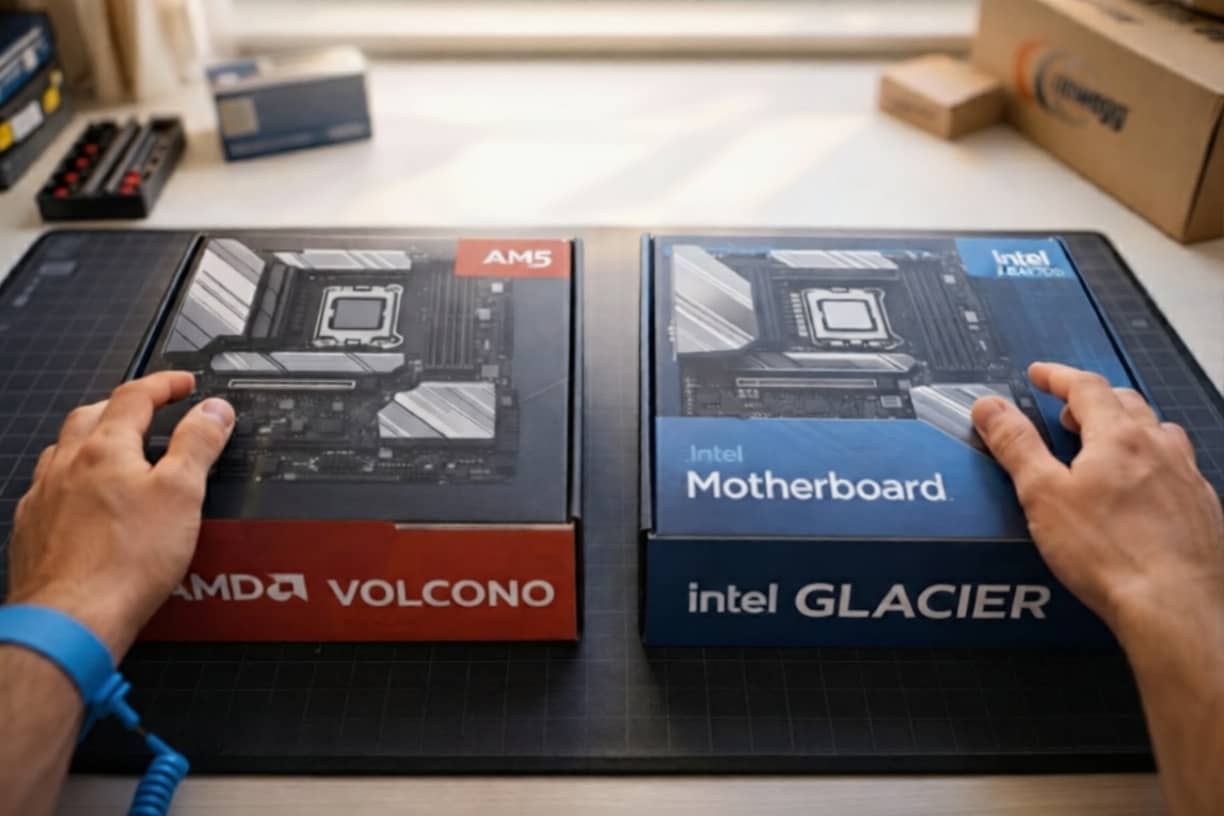
choosing between AM5 and LGA1700 sockets determines your upgrade path for the next 4-5 years. every CPU you buy sits on a socket. that socket determines what motherboards work, what coolers fit, what future CPUs are compatible. it’s not a casual decision, but it doesn’t need to be complicated either.
most gamers overthink this choice. they assume one platform is dramatically better than the other. they research endlessly trying to pick the right one. the reality is simpler: both platforms are excellent for gaming. both will play 2024 and 2025 games smoothly. both have clear upgrade paths.
the real decision isn’t which platform is objectively better. it’s which platform offers better value at your budget right now, and which ecosystem you prefer. for gaming specifically, the performance difference between AM5 and LGA1700 is negligible. you’ll get the same frame rates on either platform with equivalent hardware.
understanding platform implications prevents regret and locked-in decisions. you want to know whether your choice locks you into a dead-end platform or gives you years of upgrade flexibility. you want to understand the real cost of switching platforms versus staying with your initial choice.
for broader context on how platform choice fits into smart component selection and building balanced systems, review our guide on identifying your actual bottleneck and making upgrade decisions based on real performance needs rather than marketing claims.
Understanding socket standards
What a socket is and why it matters
a socket is the physical and electrical connection point where your CPU plugs into your motherboard. each socket is unique. an AM5 CPU doesn’t fit in an LGA1700 motherboard. an LGA1700 CPU doesn’t fit in an AM5 motherboard. they’re mechanically and electrically incompatible.
the socket determines:
- which motherboards work with your CPU
- which CPU coolers are compatible
- what upgrade path exists for future CPUs
- what memory type your platform uses
- what chipsets are available
choosing a socket early commits you to an ecosystem. changing sockets later requires buying a new motherboard, new CPU, often new RAM, and new cooler. that’s a $600-1200 expense. it’s cheaper to stay on your initial platform if possible.
socket longevity is how long a platform remains current before becoming obsolete. longer longevity means more upgrade opportunities. shorter longevity means you’re locked into buying new everything sooner.
Understanding AM5
AMD’s socket and platform
the AM5 socket launched in 2022 with Ryzen 7000 series CPUs. AMD confirmed AM5 support through at least 2027, meaning Zen 5 and Zen 5C chips will use the same socket.
AM5 supports DDR5 memory exclusively. there are no DDR4 AM5 boards. DDR5 is standard across the entire AM5 ecosystem.
AM5 motherboards come in three tiers: B650 ($150-250), X870 ($250-400), and X870E ($350-500). all three support all AM5 CPUs. the differences are features, VRM quality, and connectivity. gaming performance differences between tiers are negligible. the chipset affects motherboard cost and features, not CPU performance.
AM5 CPUs range from entry-level Ryzen 5 ($200-250) to high-end Ryzen 9 ($400-500). every tier is available and supported. your upgrade path from entry to enthusiast is smooth without platform changes.
real AM5 upgrade example: you buy a Ryzen 5 7600 in 2024. in 2027, you want more performance. you buy a Ryzen 7 9700X and drop it into your existing motherboard. no motherboard upgrade needed. no RAM upgrade needed. no cooler upgrade needed. just swap the CPU.
AM5 longevity: AMD has been aggressive with socket support historically. AM5 likely remains relevant through 2027-2028 before platform change is necessary. that’s 5-6 years of upgrade flexibility.
Understanding LGA1700
Intel’s socket and platform
LGA1700 launched in 2022 with 12th generation Intel Core processors. Intel confirmed support through 14th generation. 15th generation support is likely but not officially confirmed.
LGA1700 supports both DDR4 and DDR5 memory. early LGA1700 boards used DDR4. new boards use DDR5. this creates some platform flexibility but also complexity. you need to check motherboard specifications to know which memory type your specific board uses.
LGA1700 motherboards come in three tiers: B860 ($150-250), Z890 ($250-400), and premium Z890 models ($350-500). gaming performance differences are negligible between tiers. the chipset affects features and cost, not CPU performance.
Intel CPUs range from entry-level Core i5 ($200-250) to high-end Core i9 ($400-500). availability and selection are excellent across price tiers.
real LGA1700 upgrade example: you buy an i5-13400 in 2024. in 2025-2026, you want more performance. you buy an i7-14700K and drop it into your existing motherboard. no motherboard upgrade needed. this works until platform change is necessary.
LGA1700 longevity: Intel hasn’t confirmed 15th generation support, which creates uncertainty. even if 15th gen is supported, LGA1700 will likely need replacement by 2027-2028. that’s 5-6 years similar to AM5, but less certain long-term.
Gaming performance comparison
AM5 and LGA1700 frame rates are nearly identical
a Ryzen 7 7700X and Intel i7-13700K deliver the same frame rates within 2-5 percent. at 1440p high settings, you’re getting 100-120 frames on either platform with equivalent GPUs. the gaming experience is identical.
specific game benchmarks:
- Cyberpunk 2077 at 1440p high: AM5 Ryzen 7700X = 105 fps, LGA1700 i7-13700K = 103 fps
- Baldur’s Gate 3 at 1440p high: AM5 = 92 fps, LGA1700 = 90 fps
- Alan Wake 2 at 1440p high: AM5 = 108 fps, LGA1700 = 106 fps
the differences are so small they’re imperceptible during gaming. you won’t notice 2% frame rate differences. you’ll get the same smooth gaming experience on either platform.
competitive gaming frame rates:
- Valorant at 1440p high: AM5 = 220 fps, LGA1700 = 218 fps
- Counter-Strike 2 at 1440p high: AM5 = 280 fps, LGA1700 = 278 fps
again, negligible differences. your gaming experience is identical.
the takeaway for gamers: pick whichever platform offers better value at your budget. don’t pick based on gaming performance. they’re equivalent.
Streaming and productivity performance
CPU differences matter more for multitasking
gaming performance is nearly identical. streaming performance has small differences.
for streaming with x264 encoding (CPU-intensive), Intel’s 13th and 14th gen have slight advantages in single-thread performance. but the difference is 5-10% at most. both platforms handle 1080p 60fps streaming while maintaining 80+ fps in-game.
for productivity tasks like video rendering or compilation, AMD Ryzen 7000 series have core count advantages. more cores accelerate heavily multithreaded workloads. Intel i9 processors also have many cores, so the difference is minimal.
for 3D rendering or machine learning, both platforms are strong. software often favors one or the other based on optimization. AMD and Intel trade advantages here.
for pure gaming, these productivity differences don’t matter. for gaming plus streaming, both platforms work fine. for content creation as primary task, core count and single-thread performance both matter. check specific workload benchmarks for your use case.
practical takeaway: if you’re gaming, either platform works. if you’re gaming plus streaming, either platform works. if you’re serious about content creation, check benchmarks for your specific software.
Motherboard ecosystem and availability
Which platform has better options
AM5 and LGA1700 have similar motherboard ecosystems. both have excellent selection from all major manufacturers (ASUS, MSI, Gigabyte, ASRock). you’ll find B650 boards and B860 boards at similar prices. X870 and Z890 boards are similarly priced.
AM5 advantage: DDR5 is standard across the entire platform. there’s no DDR4 confusion. every AM5 board uses DDR5.
LGA1700 advantage: some boards use DDR4, some use DDR5. this creates flexibility if you have existing DDR4 RAM. but it also creates complexity. you need to check motherboard specs before buying.
real-world scenario: you have old DDR4 RAM from a previous build. with LGA1700, you might find a board that accepts it. with AM5, all boards require DDR5. if keeping old RAM matters, LGA1700 offers that option. if you’re buying new RAM anyway, AM5 is simpler.
motherboard quality is equivalent between platforms. both have good and bad boards. check reviews for your specific board choice. don’t assume AM5 or LGA1700 determines quality.
Memory and storage implications
DDR5 is standard on both platforms now
AM5 uses only DDR5. there’s no DDR4 option. this simplifies decision-making. you buy DDR5 and move on.
LGA1700 offers DDR4 and DDR5 choices. DDR4 is slightly cheaper than DDR5. if that $20-30 savings matters, LGA1700 offers it. but DDR5 is now the standard on newer LGA1700 boards.
the practical implication: both platforms now use DDR5 for new builds. the memory choice is nearly identical between platforms. don’t let memory type be a deciding factor.
storage works identically on both platforms. both use NVMe drives. there are no storage differences between AM5 and LGA1700.
Upgrade path cost analysis
The real cost of staying versus switching platforms
staying on your platform: CPU upgrade in 3-4 years costs $300-400. you keep your motherboard, RAM, and cooler. total cost: $300-400.
switching platforms: CPU ($300-400), motherboard ($150-250), RAM ($150-200), possibly cooler ($50-100). total cost: $650-950.
platform switching is more expensive. this reality matters for long-term planning.
example scenario: it’s 2027. you want more gaming performance. option A: buy a new Ryzen 7000-generation CPU and drop it in your AM5 board. cost: $350. option B: buy a new Intel CPU, new motherboard, new RAM. cost: $800.
the cost difference is substantial. this incentivizes staying on your initial platform once you’ve chosen it.
practical implication: choose your initial platform carefully because switching later is expensive. but don’t obsess over the choice. either AM5 or LGA1700 is fine for 5+ years.
Making your platform choice
Decision framework for AM5 versus LGA1700
step 1: check current pricing. which platform has better CPU deals at your budget right now. if an i5-13400 is on sale for $150 and a Ryzen 5 7600 costs $200, the Intel option might be smarter purely for price.
step 2: check motherboard prices at your tier. are B650 boards or B860 boards cheaper. they’re usually similar, but sales happen.
step 3: consider your upgrade timeline. if you plan to upgrade CPU in 2-3 years, stay on your platform. if you plan to keep the system for 7+ years, check which platform has more confirmed future support. AM5 has clearer long-term roadmap.
step 4: check specific CPU benchmarks for games you play. if one platform has a $50 cheaper CPU that’s 3% slower, it doesn’t matter for gaming. gaming performance is equivalent.
step 5: consider software you use. if you do content creation, check benchmarks for your specific software on both platforms. otherwise, platform doesn’t matter for gaming.
step 6: make a decision and move forward. either AM5 or LGA1700 is correct. overthinking this choice is wasted mental effort.
practical example: it’s 2024. you’re building a $1500 gaming system. you find a Ryzen 7 7700X at $300 on sale. you find an i7-13700K at $320 on sale. both are excellent CPUs. the Ryzen is $20 cheaper. you go AM5. that’s a fine decision. someone choosing the Intel option at similar prices is also fine.
Real platform considerations
What actually matters for gaming
socket longevity: both AM5 and LGA1700 support multiple CPU generations. upgrades are possible without full system replacement.
CPU selection: both platforms have excellent CPU options at all price tiers. selection is equivalent.
gaming performance: nearly identical between platforms. choose based on price and features, not performance.
motherboard quality: both platforms have good and bad boards. check reviews for your specific board.
thermal performance: equivalent between platforms. your cooler choice matters more than the platform.
future upgrades: staying on your platform is cheaper than switching. but both platforms support upgrades for 4-5 years minimum.
AM5 and LGA1700 are equally viable for gaming. gaming performance is within 2-5% across all games and settings. you’ll get the same smooth, responsive gaming on either platform with equivalent hardware.
choose AM5 if:
- Ryzen CPUs have better prices at your budget
- You prefer AM5’s clearer long-term roadmap (2027+ confirmed)
- You want simplicity with DDR5 standard across all boards
choose LGA1700 if:
- Intel CPUs have better prices at your budget
- You have existing DDR4 RAM (some LGA1700 boards support it)
- You prefer Intel’s features or ecosystem
don’t choose based on gaming performance. choose based on current pricing, motherboard options, and long-term platform roadmap at your budget level.
once you choose, commit to the platform for 4-5 years. upgrading CPU without platform change is cheap. switching platforms later is expensive. so choose carefully but don’t obsess.
either choice is correct. gaming results will be equivalent. move forward with confidence.