building a gaming PC teaches expensive lessons if you don’t pay attention. some mistakes cost just money. others cost both money and performance simultaneously. the worst mistakes do both and also create regret.
most gamers make similar mistakes because they don’t understand what actually impacts gaming performance and what doesn’t. they overspend on components that deliver no benefit. they underspend on components that are critical. they make decisions based on marketing rather than real-world performance.
the difference between an intelligent gaming PC purchase and a wasteful one at the same total budget can be 30-40% in actual gaming performance. that’s the performance delta between smart buying and careless spending. you’re paying the same money but one system delivers twice the frame rates because purchases were strategic.
understanding these mistakes before you build prevents frustration, regret, and wasted money. you’ll prioritize correctly. you’ll skip the marketing noise and focus on what actually matters. you’ll end up with a system that feels like an intelligent purchase instead of a collection of compromises.
for the broader context on how expensive mistakes fit into your overall gaming PC planning and performance targets, review our comprehensive guide on understanding which gaming PC mistakes waste the most money and how to identify and avoid costly errors in component selection, cooling, power supply choices, and upgrade timing.
Underestimating power supply importance
The cheap PSU that costs you performance
a cheap power supply is the most common budget trap. it seems like an easy place to save $50-60. the reality is far worse than wasted money. a cheap PSU causes performance degradation that makes your expensive components underperform.
when you cheap out on the power supply, voltage regulation is poor. the power delivery is unstable. your GPU and CPU receive inconsistent voltage. they reduce clock speed to protect themselves. thermal throttling happens. you lose 10-15% performance from the components you bought.
real scenario: you build a $1500 system. You spend $60 on a cheap 450-watt power supply. The recommended wattage is 550 watts. The cheap PSU is always operating near maximum. It can’t deliver stable power. Your RTX 4070 thermal throttles from voltage instability. Your frame rates drop 10-15%.
you’re losing roughly $150-200 worth of GPU performance ($1000 GPU × 15% loss) because you saved $60 on the PSU. that’s not an economy. that’s a terrible trade-off.
worse scenario: the cheap PSU fails catastrophically after 2 years. It shorts out. It takes your GPU with it. You’ve now bought the GPU twice. Your RTX 4070 ($600) is dead. The total cost is $660 (original $60 PSU + replacement $600 GPU). A quality $120 PSU would have lasted 10 years.
power supply investment is not optional luxury. it’s essential infrastructure. Calculate your peak draw (CPU TDP + GPU TDP + 100 watts for overhead). Add 20-30% headroom. That’s your target wattage. Spend $100-130 for an 80+ Gold certified PSU in that wattage range. It’s not an option. It’s a requirement.
the cost difference between cheap and quality: $50-70 depending on wattage. The performance cost of cheap: 10-15% frame rates. The reliability cost of cheap: shorter lifespan, risk of component damage. The correct choice: quality PSU every time.
Ignoring case airflow
Thermal throttling that reduces performance silently
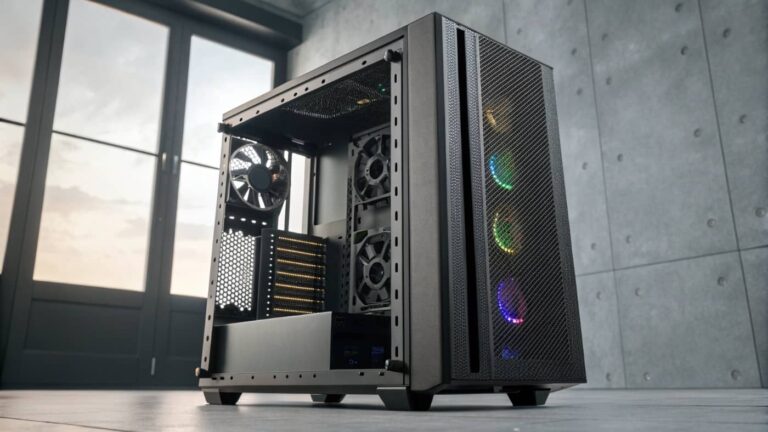
a cheap case with poor front airflow severely limits gaming performance through thermal throttling. Your GPU and CPU both reduce clock speed from overheating. Your frame rates drop 10-20% compared to the same components in a case with good airflow.
the problem: cheap cases have poor front intake area. many budget cases have solid front panels with tiny vents. the CPU cooler and GPU fans can’t draw cool air in. hot air recirculates inside. temperatures climb. components throttle.
you don’t notice the throttling. you just see lower frame rates than expected. you assume your components are weak. you don’t realize the case airflow is the problem. you consider upgrading components that actually aren’t the issue.
real scenario: you build with an RTX 4070 and Ryzen 7 7700X in a cheap case with poor front mesh. the case has a single rear exhaust fan. no front intake fans. no airflow strategy. Your GPU runs at 82°C and thermal throttles. Your CPU runs at 78°C and throttles. You get 70 frames where you should get 90 frames.
you’ve lost $200+ worth of GPU performance (20% of RTX 4070 capability) because you saved $50-60 on the case. that’s another terrible trade-off.
solution: buy a case with excellent front mesh intake area. spend $80-120 on a case specifically designed for airflow. examples include NZXT Flow, Fractal Design North, Corsair 4000D Airflow, Lian Li Lancool 216. add case fans if needed. proper airflow costs less than losing performance.
the cost difference: $50-70 between cheap and quality case. The performance difference: 10-20% frame rates from thermal throttling. The correct choice: quality airflow case every time.
thermal management hierarchy: first, get a case with good airflow. second, add adequate CPU cooling. third, ensure GPU has adequate space. a good case is foundational to everything else.
Pairing mismatched CPU and GPU
When expensive components sit underutilized
pairing a high-end GPU with a budget CPU creates severe bottlenecks where the GPU can’t get work. You pay high-end GPU money but get mid-range performance because the CPU can’t feed work fast enough.
real scenario: you buy an RTX 4080 ($1000+) to pair with your old Ryzen 5 5600 CPU ($150). you’re excited about the performance jump. In reality, the RTX 4080 is so powerful that your CPU can’t feed it work fast enough. the GPU runs at 60% utilization instead of 95-100%. you get the performance of an RTX 4070 instead of RTX 4080. you wasted $600 on GPU capacity you can’t use.
the reverse problem: you buy a Ryzen 9 9900X ($450) with an RTX 4060 Ti ($330). The CPU is powerful but the GPU can’t utilize it. The CPU idles waiting for the GPU. You paid $450 for CPU power that goes unused.
component matching is critical. a $300 CPU should pair with a $300-400 GPU. a $500 CPU should pair with a $500-600 GPU. this ensures both components are fully utilized.
matching guide: research your target resolution and frame rate. find what GPU hits that target. find what CPU pairs well with that GPU. don’t overspend on one while underspecifying the other.
the cost of mismatching: wasted money on unused component capacity. a $1000 GPU with a $150 CPU wastes $600 of GPU potential. that’s the cost of poor matching.
Prioritizing specs over actual performance
Why VRAM and core counts mislead
you see a 12GB GPU and an 8GB GPU at the same price and assume 12GB is better. you see a 16-core CPU and an 8-core CPU and assume 16 cores is better. these assumptions are wrong often enough to cost real money.
VRAM myth: an 8GB RTX 4060 Ti and a 12GB RTX 4060 Ti perform identically at 1080p gaming. they also perform identically at 1440p. the extra VRAM does nothing. you’re paying for capacity you’ll never use. VRAM only matters if you exceed the limit, which doesn’t happen at 1080p or 1440p in standard games.
core count myth: a game that uses 4 cores perfectly has zero benefit from a 16-core CPU. the 8 extra cores sit idle. if you’re gaming 80% of the time and streaming 20% of the time, a 16-core CPU helps for streaming. but it’s worthless for pure gaming performance. you’re paying for capacity you don’t need for gaming.
real scenario: you’re comparing two GPUs at the same price. one is RTX 4070 with 12GB VRAM. the other is RTX 4070 Super with 12GB VRAM. You pick the 4070 because the 4070 Super doesn’t have better specs on paper. Actually, the 4070 Super has more CUDA cores and higher memory bandwidth. The 4070 Super is 15-20% faster in real games. Specs misled you. You picked the worse card.
the fix: prioritize actual performance metrics. for GPUs: CUDA cores and memory bandwidth matter. memory speed and total VRAM matter less than you think. for CPUs: single-core performance and core count for your specific workload matter. base clock and boost clock matter more than core count if you’re gaming only.
check benchmarks in games you actually play. when choosing CPUs, check performance in gaming scenarios you’ll use. ignore specs. check real-world performance.
Buying cheap cooling despite expensive CPUs
Stock cooling on high-end CPUs causes throttling
a $300 Ryzen 7 or i7 with stock cooling thermal throttles under sustained gaming load. the stock cooler is designed for the CPU’s rated TDP, not for aggressive gaming stress. your CPU hits 85-90°C and reduces clock speed to stay cool. you lose 10-15% performance.
the stock cooler costs $0 (included). a quality tower cooler costs $30-50. an AIO cooler costs $80-120. you’re choosing between losing performance or spending $30-120. the choice is obvious.
real scenario: you buy a Ryzen 7 7700X ($320). You use stock cooling. During gaming, the CPU hits 88°C and throttles. Your frame rates are 10-15% lower than they should be. A $50 tower cooler prevents this. You lose more performance value ($1000+ in GPU capability not fully utilized) by saving $50 on cooling.
the investment in cooling is essential to getting the performance you paid for. your CPU costs $300. your GPU costs $500-600. you’re protecting $800-900 of investment by spending $50 on a cooler. the math is obvious.
cooling hierarchy: stock cooling is adequate for budget CPUs under normal loads. quality tower cooling ($30-50) is essential for mid-range CPUs. AIO cooling ($80-120) is appropriate for high-end CPUs where thermal performance matters.
thermal throttling is silent performance loss. you don’t notice it happening. you just see lower frame rates than expected. monitoring reveals it. if your CPU is hitting 85°C+ and throttling, cooling is your bottleneck, not component power.
Using slow storage
How SATA SSD creates bottlenecks throughout your system
buying a SATA SSD to save $20 instead of NVMe SSD creates multiple problems. slow storage affects game load times, system responsiveness, and asset streaming.
real scenario: you pair an RTX 4070 with a SATA SSD instead of NVMe. Game load times increase from 45 seconds to 2 minutes. System responsiveness feels sluggish. When you travel to new areas in open-world games, you get stuttering while assets load from slow storage. You spent $20 saving and created multiple problems.
NVMe has become cheap enough that SATA is no longer worth buying. Gen3 NVMe costs similar amounts to SATA and delivers 4-5x faster performance. Gen4 NVMe costs slightly more and delivers 7-8x faster performance than SATA.
storage impact: SATA SSD has 500-550 MB/s read speed. NVMe Gen3 has 3500+ MB/s. NVMe Gen4 has 7000+ MB/s. When loading game assets, the speed difference is dramatic. SATA takes multiple seconds to load textures. NVMe loads them in milliseconds.
proper storage strategy: use a 500GB-1TB NVMe Gen4 for your OS and primary applications. add a 2TB NVMe Gen3 for games and projects. this strategy gives you speed where it matters and capacity where you need it. total cost is similar to buying slow larger storage.
storage doesn’t affect in-game frame rates much once assets are loaded. but it affects load times, asset streaming stuttering, and overall system responsiveness. investing in fast storage improves your daily PC experience noticeably.
the cost difference: $20-40 between SATA and NVMe. the experience difference: significant improvement in load times and responsiveness. the correct choice: NVMe always.
Ignoring RAM timing and capacity
DDR5 CAS 30 versus CAS 14 and 16GB versus 32GB
you assume all DDR5 3600MHz RAM performs identically. you buy the cheapest option to save $20. the cheapest option has CAS 30 latency. the expensive option has CAS 14 latency. the difference is real and noticeable.
DDR5 3600MHz CAS 30 versus DDR5 3600MHz CAS 14 affects gaming responsiveness measurably. the lower latency option feels snappier. camera movement feels more responsive. aiming feels tighter. the frame rate is similar but responsiveness is noticeably different.
real scenario: you’re comparing two DDR5 3600MHz kits at $150 and $180. the cheaper one is CAS 30. the expensive one is CAS 14. you save $30 by picking the cheap one. in gaming, the cheap one feels slightly sluggish compared to the expensive one. the $30 savings cost you noticeable responsiveness. bad trade-off.
RAM capacity: 16GB is minimum for gaming. 32GB becomes important when multitasking or streaming. upgrading from 16GB to 32GB costs $100-150 and improves stability noticeably in heavy scenes.
for competitive gaming, tight timings matter more than speed. a CAS 14 kit at 3600MHz feels more responsive than a CAS 18 kit at 4000MHz. prioritize latency over frequency.
for single-player gaming, the responsiveness difference is less critical but still present. the $30-50 difference in RAM cost is worth the responsiveness improvement and stability gain.
proper RAM selection: prioritize tight timings (CAS 14-16) over high frequency for gaming. if you’re choosing between 3600MHz CAS 14 and 4000MHz CAS 18, pick the 3600MHz CAS 14. buy 32GB for comfortable headroom in heavy games and multitasking.
Building for hypothetical future needs
The cost of imaginary use cases
you don’t stream now but think you might someday. so you buy a Ryzen 9 CPU and high-end cooling. you spend $400 on CPU power you’re not using today. when you actually want to stream in 3 years, you’ll want to upgrade anyway because new CPUs are faster. your $400 investment in future-proofing becomes wasted.
you don’t do 8K video editing now but assume you might. so you buy an RTX 4090 ($1500) and 256GB RAM ($4000). total: $5500 on capability you might never use. in reality, you’ll game at 1440p. the 4090 is overkill. the 256GB RAM is absurd.
real scenario: you build a system expecting to stream someday. you buy a Ryzen 9 at $400 and high-end everything. total cost: $2500. you use it for pure gaming for 2 years. then you want to try streaming and realize you want a newer, faster CPU anyway. your $400 CPU investment is wasted. you should have built for current needs.
the fix: build for current use cases. upgrade when actual needs appear. if you’re gaming today, optimize for gaming. if you want to stream in the future, upgrade the CPU then. don’t pay for future capacity you might never use.
over-specifying wastes massive amounts of money. build smartly for what you actually do today. upgrade when needs change.
Upgrading too frequently
The cost of chasing marginal improvements
upgrading your GPU every year yields 10-15% performance improvement per upgrade. that’s marginal. upgrading every 2-3 years yields 40-60% improvement. that’s substantial and justifiable.
the yearly upgrade path: spend $500 on a new GPU. gain 10% performance. the performance gain is barely noticeable. frame rates increase by 5-10 frames. most users don’t notice. wasteful spending.
the 2-3 year upgrade path: wait 2-3 years. spend $500 on a GPU. gain 50% performance. the improvement is substantial. frame rates increase 50-70 frames. noticeable improvement. good value.
compound cost of yearly upgrading: spend $500/year for 3 years = $1500 total. gain 10% + 10% + 10% = 30% cumulative improvement. versus wait 3 years, spend $500 once, gain 50% improvement. the waiting approach is cheaper and delivers better results.
diminishing returns example: RTX 4070 costs $500. RTX 4070 Super costs $550. Performance improvement is 12%. For $50 more, you get 12% better performance. marginal value. Wait for RTX 4080 or next generation. The improvement will be 40%+ for similar cost.
upgrade frequency recommendation: GPU every 2-3 years. CPU every 4-5 years. Anything more frequent is wasteful. anything less frequent means playing below your target performance unnecessarily.
plan for upgrades financially. if you expect to upgrade GPU in year 3, budget $500 for that. save monthly so the upgrade doesn’t shock your finances. planned upgrades are smart. reactive panic upgrades are wasteful.
Not researching before buying
How skipping research costs you money
not researching components before buying is perhaps the most expensive mistake. you read marketing copy. you assume specs mean performance. you buy poorly reviewed components. you end up with problems.
real scenario: you read marketing claiming “12GB GPU is better than 8GB GPU.” You buy the 12GB model. later you discover the 8GB model is actually 15% faster because it has better CUDA cores. The marketing misled you. you picked the worse card based on specs instead of performance.
another scenario: you buy a cheap motherboard to save $50. it has poor VRM quality. your CPU doesn’t get stable power delivery. you experience crashes and instability. you spend $50 on a replacement board plus hours of troubleshooting. The cheap board cost you way more than the savings.
research takes 2-3 hours. reading reviews, checking benchmarks, comparing specifications in reputable tech sites. that 2-3 hours of research prevents most mistakes. it’s time well spent.
proper research process: identify your target performance (1440p 100 frames). research what GPU hits that target. research what CPU pairs well. check reviews on that specific GPU and CPU model. look at real benchmark numbers, not marketing claims. read user reviews for reliability feedback. make purchasing decisions based on data.
gaming PC mistakes are preventable. understanding what actually matters helps you avoid them.
avoid cheap power supplies. they cause thermal throttling and risk component failure. spend $100-130 on quality PSU.
avoid poor case airflow. thermal throttling costs 10-20% performance. spend $80-120 on quality airflow case.
avoid mismatched CPU and GPU. pairing them in the same performance tier ensures both are utilized.
avoid prioritizing specs over performance. check benchmarks. ignore marketing.
avoid cheap cooling on expensive CPUs. spend $50-120 on adequate cooling to prevent throttling.
avoid SATA SSD. NVMe is cheap now. get fast storage.
avoid poor RAM timing and low capacity. tight timings matter for responsiveness. 32GB is standard now.
avoid building for hypothetical needs. build for actual needs today.
avoid upgrading too frequently. upgrade every 2-3 years for good value. yearly upgrades are wasteful.
avoid buying without research. spend 2-3 hours researching before purchasing. research prevents expensive mistakes.
follow this guidance and your gaming PC purchase is intelligent. you avoid wasteful mistakes. you prioritize correctly. you get maximum performance for your budget. you avoid regret.