building a gaming PC that feels relevant for 5+ years requires strategic planning, not just buying the newest components. most gamers don’t think about longevity. they build optimized for today. they ignore tomorrow. then in 3 years they feel the system is underpowered and regret their choices.
the truth is simpler: you can build today in a way that ages gracefully. it requires understanding which components matter for longevity and which become irrelevant quickly. it requires choosing platforms with long upgrade paths instead of dead-end sockets. it requires investing in infrastructure that supports future upgrades.
future-proofing doesn’t mean buying the most expensive components. it means buying smart components that keep their relevance through changing game demands. it means choosing platforms where CPU upgrades are cheap and easy. it means avoiding choices that lock you into expensive platform changes.
understanding how to build for longevity saves thousands of dollars over your PC’s lifespan. you’ll skip expensive platform changes. you’ll make single-component upgrades instead of replacing entire systems. you’ll feel satisfied with your PC for years instead of disappointed after one.
for the comprehensive strategic overview of how long-term planning integrates with your overall gaming PC building approach and upgrade decisions, review our essential guide on understanding how to build and maintain gaming systems that deliver sustained performance and relevance through intelligent component selection, platform choice, and strategic upgrade planning that keeps your PC current for 5+ years.
What makes a gaming PC future-proof
Relevance over time, not peak performance
a future-proof gaming PC isn’t about having the fastest hardware today. it’s about having a system that stays relevant as games evolve. relevance means hitting your target frame rate and settings at your target resolution for years, not just months.
a system built in 2024 to deliver 1440p 100 frames should still deliver 1440p 80-90 frames in 2027. that’s graceful aging. a system that drops from 100 to 50 frames is aging poorly.
the key factors for longevity: balanced components (GPU and CPU roughly matched in performance tier), adequate cooling and power infrastructure, smart platform choice, room for GPU upgrade without platform change.
what makes systems age poorly: overly cheap initial components that throttle, mismatched GPU and CPU that create inefficiency, dead-end platforms with no upgrade path, components cutting corners on reliability.
future-proofing is about building for 5-year ownership, not 10-year ownership. trying to be relevant beyond 5 years is impossible. game demands change too fast. what’s reasonable in 2024 becomes unrealistic by 2029. plan for 5 years. reassess at year 5.
The role of GPU in long-term relevance
Your GPU needs upgrades more than any other component
your GPU becomes the limiting factor every 3-4 years. games released in year 4 and 5 demand more GPU power than your initial purchase. that’s the reality of GPU technology evolution.
the solution: choose a GPU that can support a meaningful upgrade. buying the cheapest RTX 4060 Ti ($300) means your upgrade path is limited. the next tier up (RTX 4070) costs $500. that’s $500 for maybe 30% more performance. upgrading to RTX 4090 is too expensive for marginal gaming improvement.
smarter: buy RTX 4070 ($500) initially. in year 4, upgrade to RTX 4090 or equivalent next-gen ($800-1000). that $800 jump delivers 50-60% performance improvement. worth it.
the math of GPU longevity:
option A: RTX 4060 Ti today ($300). Upgrade to RTX 4070 in year 4 ($500). Total over 4 years: $800. Performance trajectory: moderate → moderate (limited headroom for future).
option B: RTX 4070 today ($500). Upgrade to RTX 4090 in year 4 ($900). Total over 4 years: $1400. Performance trajectory: good → excellent (better future relevance).
option A saves $600 initially but limits your upgrade ceiling. option B costs more upfront but keeps you relevant longer.
for true future-proofing: start with RTX 4070 or better. plan a GPU upgrade in year 3-4. the upgrade will be expensive but necessary.
CPU longevity and platform implications
Your CPU stays relevant longer than your GPU
CPUs age much slower than GPUs. a Ryzen 7 7700X or i7-13700K bought in 2024 is still quite capable in 2028. it won’t need replacement. it might need a modest upgrade to avoid becoming the bottleneck if you upgrade your GPU, but replacement isn’t urgent.
the advantage: if you choose your platform well, you can upgrade CPU without platform change. a Ryzen 7 → Ryzen 9 upgrade on AM5 costs $400-500 and works. you keep your motherboard, RAM, cooler. you just swap the CPU.
platform choice determines cost of future CPU changes. AM5 with confirmed support through 2027+ means cheap CPU upgrades through that period. LGA1700 with uncertain support beyond 14th gen means potential platform change coming.
CPU future-proofing strategy: choose a platform with clear, extended support roadmap. prefer AM5 if longevity is your priority. if you choose LGA1700, understand you might need platform change in 4-5 years.
the cost difference between CPU upgrade and platform change: CPU upgrade alone is $300-500. platform change (CPU + motherboard + RAM + cooler) is $800-1200. choosing a platform with longevity saves $300-700 per upgrade cycle.
Memory and storage longevity
Infrastructure that lasts the entire ownership cycle
RAM you buy today stays relevant your entire PC lifespan. 32GB DDR5 bought in 2024 is still perfect in 2029. RAM doesn’t become obsolete. it just gets cheaper as standards advance.
future-proof RAM strategy: buy 32GB from the start. don’t cheap out to 16GB thinking you’ll upgrade. you probably won’t. 32GB eliminates any chance of memory pressure in gaming. it’s one less potential bottleneck.
DDR5 vs DDR4: buy DDR5. DDR4 is approaching end-of-life. DDR5 will be your standard for this platform cycle. don’t buy DDR4 thinking it’s cheaper. it’s not worth the complexity.
storage: NVMe Gen4 is appropriate for this generation. Gen3 works but Gen4 is the current standard. don’t buy SATA SSD. it’s outdated technology.
future-proof storage strategy: 1TB primary Gen4 NVMe for OS and main games. 2TB secondary Gen4 for additional games. this combination gives speed where it matters and capacity where you need it. total cost: $150-200. this setup outlasts your entire GPU upgrade cycle.
Cooling and PSU as foundation
Infrastructure that enables future upgrades
cheap cooling and power supply bite you in the future. you invest in a nice GPU upgrade in year 4. your cheap PSU can’t handle it. you need new PSU. your cheap cooler can’t keep a new CPU cool. you need new cooler. budget problems multiply.
future-proof power supply: buy 850-1000 watt 80+ Gold PSU today. it’s $100-150. this PSU has enough headroom for GPU upgrades through year 5+. it’ll last the entire ownership cycle.
future-proof cooling: invest in adequate CPU cooling ($50-100). a quality tower cooler or small AIO will handle CPU upgrades without replacement. you won’t need new cooling for your new CPU.
the false economy: saving $50 on PSU and $50 on cooler today costs $300-400 when you need replacements for GPU upgrade in year 4. bad trade-off.
future-proof strategy: spend $150-200 extra on good power and cooling today. eliminate future bottlenecks. your GPU upgrades in year 4 work seamlessly because infrastructure supports them.
Case and airflow longevity
Your case outlasts every component except the frame
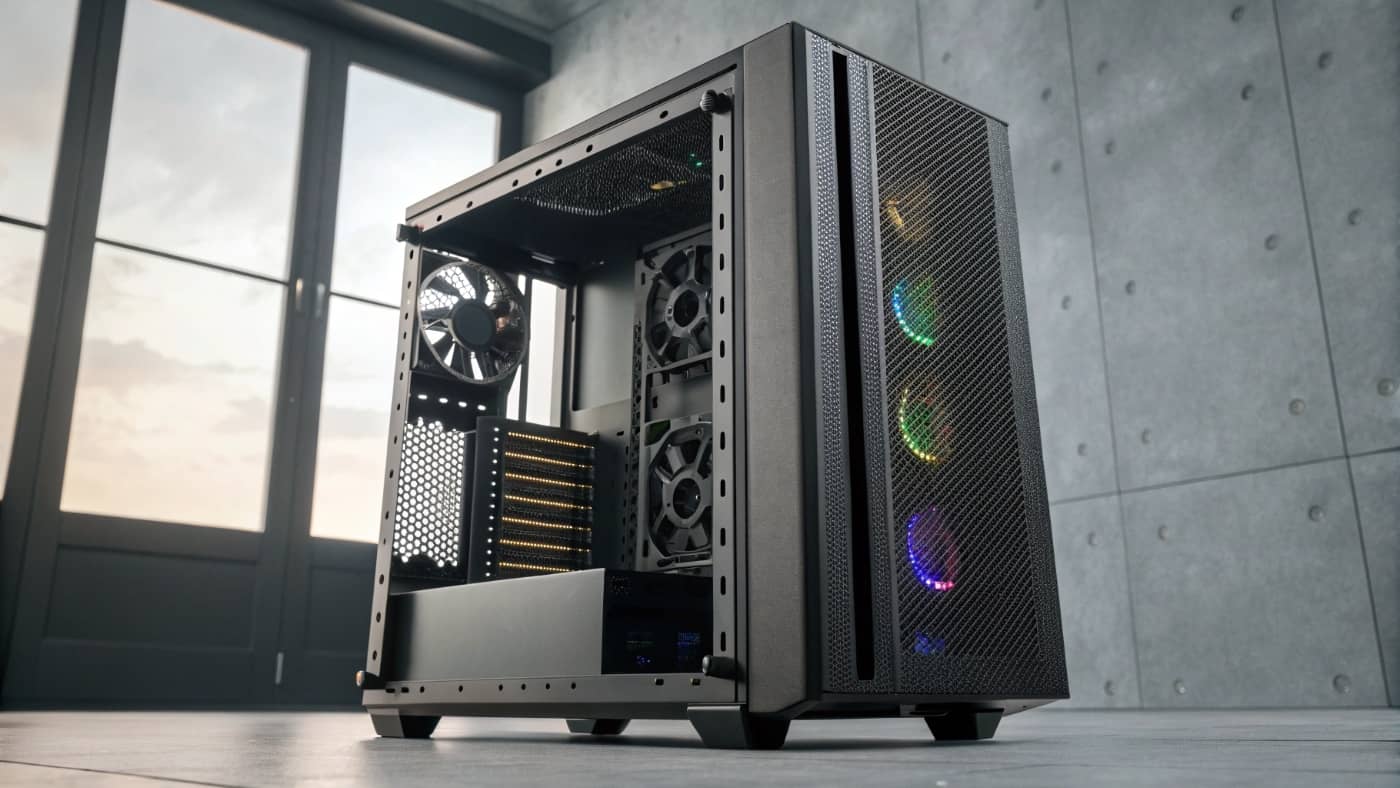
your case never needs replacement. it outlasts your PC ownership cycle. invest in quality airflow now. thermal throttling in year 2 from poor airflow is preventable by spending $80-120 on a good case today.
future-proof case strategy: buy NZXT Flow, Fractal Design North, or Corsair 4000D Airflow. excellent front mesh. good expansion room. adequate cooling for every component upgrade you’ll make.
cheap case pitfalls: poor airflow becomes obvious in year 2-3 when new games demand more GPU power. thermals spike. throttling occurs. upgrading case at that point means uninstalling and reinstalling every component.
case longevity: a good case bought in 2024 will house your 2027 GPU upgrade, 2028 CPU upgrade, and every storage/cooler change you make. it’s the foundation everything builds on. invest here.
Building for five-year ownership
Year-by-year upgrade strategy
year 1: your new system is excellent. no upgrades needed. enjoy gaming at your target performance.
year 2: games are more demanding. your frame rates drop slightly. you’re still hitting your target but with less headroom. monitor performance. don’t upgrade yet.
year 3: demanding games hit your system harder. you’re below target frame rate in some games. this is when GPU upgrade becomes attractive. upgrading GPU costs $500-700. you see 30-50% frame rate improvement. worth it.
year 4: after GPU upgrade, CPU might start showing its age. demanding new games might show CPU bottleneck in some scenarios. consider CPU upgrade if it bothers you. CPU upgrade costs $300-400 if staying on platform. might be worth it.
year 5: reassess. does your system still deliver target performance? if yes, keep it. if no significantly, plan year 5-6 for decision: continue with components upgrade or build new.
total cost over 5 years: $1500 initial + $600 GPU upgrade + $350 CPU upgrade = $2450. that’s $490/year for top-tier gaming. excellent value.
Platform choice impacts future-proofing
Locking yourself in or keeping options open
AM5 with confirmed 2027+ support locks you into the platform for years. that’s good. CPU upgrades are cheap. you stay on platform.
LGA1700 with uncertain 15th gen support creates uncertainty. you might need platform change by 2027. that’s expensive. upgrading to new Intel platform with 15th or 16th gen CPU costs $800-1000.
future-proof strategy: choose AM5 if longevity is your priority. you know you can upgrade CPU cheaply for 5+ years. LGA1700 works if you’re okay with platform change around year 5.
the cost difference: AM5 allows $400-500 CPU upgrade. LGA1700 might force $900-1100 platform change. that’s $400-600 more expensive.
Game demands evolution and your PC
How games change and what that means
2024 games: 1440p high settings at 100 frames requires RTX 4070 + Ryzen 7 or i7.
2026 games: demanding games push to RTX 4070 Super / RTX 4080 performance. Ryzen 7 / i7 still adequate.
2028 games: demanding games require RTX 4090-level GPU. Ryzen 7 / i7 becoming borderline in some games.
2030 games: GPU from 2024 handles 1080p comfortably. 1440p compromises needed. 4K unrealistic.
trajectory: if you build 1440p 100 frames in 2024, you’ll get 1440p 70-80 frames in 2027. 1440p 50-60 frames in 2029. that’s acceptable graceful aging if your goal was 5-year ownership.
if you want 1440p 100 frames in 2028, you need GPU upgrade. that’s planned. that’s fine. upgrade spending is expected.
future-proofing doesn’t mean unchanged performance. it means acceptable aging. your target frame rate declines gradually. your resolution doesn’t drop. your settings compromise slowly.
Avoiding future bottlenecks
Build balanced today to avoid obsolescence later
matching GPU and CPU in performance tier prevents bottlenecks today and tomorrow. a Ryzen 7 (high performance CPU) paired with RTX 4070 (high performance GPU) stays balanced through upgrades.
in year 4, if you upgrade GPU to RTX 4090, the Ryzen 7 becomes bottleneck in some CPU-intensive games. but it’s still adequate. you can still game. you’re just not fully utilizing the RTX 4090. that’s acceptable.
mismatched initial components create problems. a Ryzen 5 paired with RTX 4090 creates immediate bottleneck. the GPU isn’t fully utilized. you wasted money. by year 4 when GPU upgrade is needed, you also need CPU upgrade. you’re forced into $800 spending instead of $600 GPU-only spending.
future-proof component matching: GPU should be same performance tier as CPU or slightly higher. If CPU tier is “mid-range” ($300-350), GPU should be $400-500. This ensures both have years of usefulness.
The total cost of ownership calculation
What future-proofing really costs
common misconception: future-proofing means spending more money. reality: it means spending smarter. intelligent future-proofing often costs less than reactive poor planning.
scenario A (reactive, cheap initial build):
- Year 1: $1000 system (budget GPU, budget cooler, cheap PSU)
- Year 3: PSU dies, need replacement ($120)
- Year 3: GPU upgrade to RTX 4070 ($500) – but cheap cooler can’t handle new CPU
- Year 3: Cooler replacement ($80)
- Year 4: CPU upgrade to handle new GPU ($300 + motherboard $180 = $480)
- Year 5: Storage upgrade from SATA to NVMe ($100)
- Total over 5 years: $2280
scenario B (strategic, smart initial build):
- Year 1: $1500 system (good GPU, quality cooler, good PSU, NVMe storage)
- Year 3: GPU upgrade to RTX 4090 ($800) – cooler and PSU handle it fine
- Year 4: CPU upgrade optional ($350)
- Total over 5 years: $2650
difference: $370 more for scenario B. but scenario B avoids reactive failures, avoids cheap component problems, avoids extra replacement costs. scenario B is smoother and more satisfying.
better scenario C (truly future-proof):
- Year 1: $1800 system (RTX 4070, Ryzen 7, quality everything)
- Year 3: GPU upgrade ($700)
- No other upgrades needed
- Total over 5 years: $2500
scenario C is most future-proof. balanced components in year 1 mean minimal upgrades needed. total cost is lower and satisfaction is higher.
Making the future-proof choice
Building with intention for longevity
future-proof doesn’t mean spending the most. it means spending smartly on things that enable long ownership.
invest in:
- Balanced GPU and CPU (within same performance tier)
- Quality power supply (850W+, 80+ Gold)
- Adequate cooling (not cheap, but not luxury)
- Good case with airflow (NZXT Flow, Corsair 4000D)
- Fast storage (NVMe Gen4)
- 32GB RAM (current standard)
- Platform with clear upgrade path (AM5 preferred for longevity)
skip:
- Exotic case with poor airflow
- RGB everything (doesn’t impact performance)
- Oversized PSU (1200W+)
- Overpriced premium components (diminishing returns)
- Dead-end platforms with no upgrade path
the future-proof choice: intelligent spending on infrastructure, moderate spending on performance components, strategic platform choice, planned upgrade timeline.
Your five-year vision
Planning your PC’s lifecycle
when building, ask yourself: where do I want to be in 5 years?
if your answer is “1440p 80+ frames at high settings,” build a $1500 system today and plan GPU upgrade in year 3.
if your answer is “1440p 120+ frames at ultra settings,” build a $1800 system today and plan GPU upgrade in year 4.
if your answer is “same performance as today,” accept that’s impossible. games demand more power. plan for graceful aging, not unchanged performance.
realistic future vision: your 2024 system hits 1440p 100 frames. in 2027, it hits 1440p 70-80 frames. in 2030, it hits 1080p 100 frames or 1440p 40-50 frames. that’s acceptable aging. that’s planned.
building with clear future vision means you make intentional decisions now that support that vision. you invest in infrastructure. you choose platforms with longevity. you accept that upgrades will happen and budget for them.
building a future-proof gaming PC requires strategic thinking about component selection, platform choice, and planned upgrades. it’s not about spending the most. it’s about spending smart.
invest in infrastructure: quality power supply, good cooling, excellent case, fast storage, adequate RAM. these outlast your ownership cycle and enable upgrades.
choose a balanced initial system: GPU and CPU in the same performance tier. avoid bottlenecks today and tomorrow.
choose your platform carefully: prefer AM5 if longevity matters. understand LGA1700 might require platform change in year 5.
plan for GPU upgrade in year 3-4: that’s realistic and necessary. budget for it.
plan for CPU upgrade in year 4-5: might be unnecessary, but have it available as option.
accept graceful aging: your 1440p 100 frames in 2024 becomes 1440p 70-80 frames in 2027. that’s acceptable. that’s planned.
total ownership cost: $2500-3000 over 5 years for top-tier gaming. that’s $500-600 per year. excellent value.
building for future-proofing isn’t expensive. it’s smart. it’s satisfying. it’s sustainable. it prevents regret and expensive mistakes. it’s the right approach to gaming PC building.