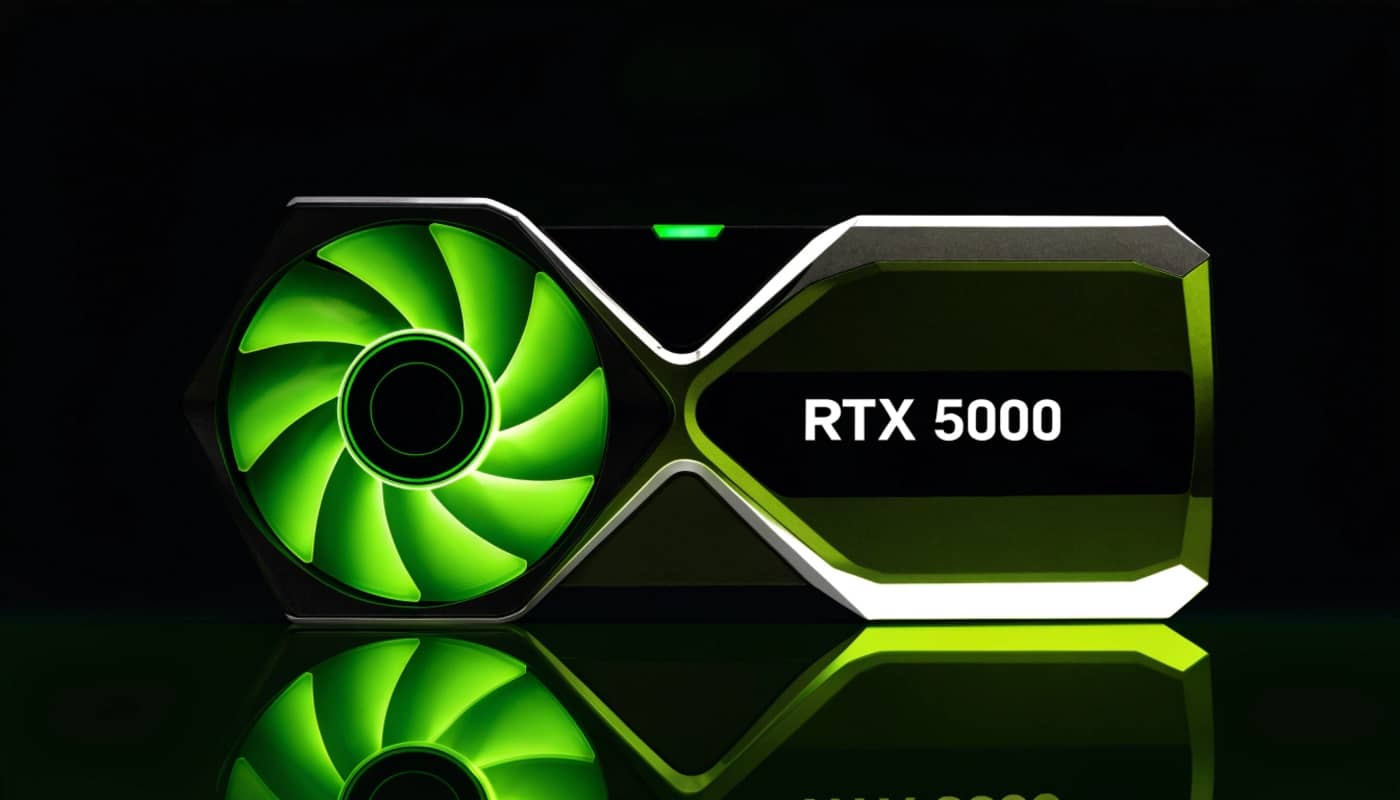
NVIDIA officially launched its GeForce RTX 5000 series GPU lineup at CES 2025, introducing the next generation of consumer graphics cards built on the Blackwell architecture. The release marks NVIDIA’s first major consumer GPU generation since the Ada Lovelace-based RTX 4000 series, bringing significant changes to rasterization performance, AI-accelerated rendering, and memory bandwidth across the product stack.
Launch lineup and availability
The RTX 5000 series launched with four models targeting different market segments. The flagship RTX 5090 and RTX 5080 were made available first, followed by the RTX 5070 Ti and RTX 5070 in subsequent weeks. Lower-tier models including the RTX 5060 Ti and RTX 5060 are scheduled for release later in 2025.
The RTX 5090 carries a recommended retail price of $1,999. The RTX 5080 launches at $999. The RTX 5070 Ti is priced at $749 and the RTX 5070 at $599. Actual street pricing at launch exceeded MSRP across most markets due to limited initial stock availability.
The cards are manufactured on TSMC’s 4NP process node and use GDDR7 memory across the entire lineup — a first for a mainstream consumer GPU generation.
Architecture blackwell key changes
The Blackwell architecture introduces several structural changes relevant to gaming performance compared to Ada Lovelace.
Shader processor counts increase substantially across the stack. The RTX 5090 features 21,760 CUDA cores compared to the RTX 4090’s 16,384. The RTX 5080 ships with 10,752 CUDA cores versus the RTX 4080 Super’s 10,240, representing a more modest generational step at this tier.
GDDR7 memory replaces GDDR6X across the lineup, delivering significantly higher memory bandwidth. The RTX 5090 achieves 1,792 GB/s of memory bandwidth compared to the RTX 4090’s 1,008 GB/s — a 78 percent increase that directly benefits memory-bandwidth-constrained workloads including high-resolution texture rendering and ray tracing calculations.
The fifth-generation Tensor Cores in Blackwell enable DLSS 4, NVIDIA’s updated AI upscaling solution. The primary addition in DLSS 4 is Multi Frame Generation, which uses AI to generate up to three additional frames per rendered frame rather than the single additional frame DLSS 3 Frame Generation produced. This technology is exclusive to RTX 5000 series hardware.
Gaming performance measured results
Independent benchmark data published across multiple hardware testing publications at launch established the following performance picture across common gaming resolutions.
The RTX 5090 delivers approximately 30 to 40 percent higher rasterization performance than the RTX 4090 at 4K without upscaling. In ray tracing workloads, the margin widens to 40 to 50 percent due to the increased memory bandwidth and upgraded RT Core configuration. This positions the RTX 5090 as the first consumer GPU capable of stable 4K 60fps in demanding ray-traced titles without upscaling assistance across a broad range of games.
The RTX 5080 shows more variable generational gains. Against the RTX 4080 Super, rasterization performance improvements at 4K range from 15 to 25 percent depending on title and workload. The step up from an RTX 4080 non-Super is more meaningful at approximately 25 to 35 percent. The RTX 5080 establishes itself as a strong 4K 144Hz capable card in most titles at High to Ultra settings with DLSS Quality assistance.
The RTX 5070 Ti represents the clearest value proposition in the launch lineup based on performance-per-dollar metrics. Benchmark data places it between 5 and 10 percent behind the RTX 5080 in most gaming workloads at a $250 lower price point. At 1440p, the RTX 5070 Ti delivers performance comfortably above 144fps in the majority of tested titles at High settings.
The RTX 5070 targets the 1440p 60fps to 100fps range at High settings. In direct comparison to its predecessor, the RTX 4070 Super, the RTX 5070 shows approximately 20 to 30 percent performance improvement in rasterization. The $599 price point positions it above the RTX 4070 Super’s launch MSRP, which represents a price increase at this performance tier that will factor into upgrade decisions for mid-range buyers.
DLSS 4 and multi frame generation technical Context
DLSS 4 Multi Frame Generation is the most technically significant new feature exclusive to RTX 5000 series hardware, and its real-world impact requires precise characterization to avoid misrepresentation.
Multi Frame Generation increases output frame rates substantially in supported titles. In games where the base rendered frame rate is 60fps, Multi Frame Generation at its maximum setting can produce output frame rates exceeding 240fps. The critical caveat is that generated frames carry input latency that scales with the number of frames generated. NVIDIA’s Reflex technology mitigates this latency increase, but the trade-off between output frame rate and input responsiveness is a technical reality that competitive gaming applications need to evaluate carefully.
For single-player titles and applications where visual smoothness is the primary metric, Multi Frame Generation delivers a meaningfully improved experience at its current implementation quality. For competitive multiplayer applications where input latency directly affects gameplay outcomes, the base rendered frame rate remains the more relevant performance metric regardless of generated frame output numbers.
DLSS 4 also introduces an updated Transformer-based neural network model for its upscaling algorithm, replacing the previous CNN-based model. This update is available on RTX 4000 series hardware as well as RTX 5000 series, delivering image quality improvements in upscaling and frame generation for Ada Lovelace cards through a driver update.
Memory capacity across the stack
VRAM allocation in the RTX 5000 series has been a point of industry discussion, particularly at the mid-range tier. The RTX 5090 ships with 32GB of GDDR7. The RTX 5080 carries 16GB. The RTX 5070 Ti and RTX 5070 both ship with 12GB.
The 12GB allocation on the RTX 5070 Ti has drawn attention given that the card targets high-refresh-rate 1440p and entry-level 4K gaming. Current game titles at 4K Ultra settings with high-resolution texture packs are approaching and in some cases exceeding 12GB VRAM consumption on competing hardware. Whether 12GB represents a practical limitation for the RTX 5070 Ti’s target use case will become clearer as game releases through 2025 and 2026 scale their texture and asset requirements.
The RTX 5080’s 16GB configuration is generally considered adequate for its 4K target market at current and near-term title requirements.
Power consumption
The RTX 5090 carries a Total Graphics Power rating of 575 watts, an increase from the RTX 4090’s 450 watts. This requires a minimum 1000-watt power supply recommendation from NVIDIA and a new 16-pin power connector configuration. The RTX 5080 is rated at 360 watts, the RTX 5070 Ti at 300 watts, and the RTX 5070 at 250 watts.
The power increases across the stack are meaningful for system builders evaluating power supply capacity and thermal management requirements. Cases with limited airflow and existing power supply units below recommended capacity will require assessment before installation.
Industry and market context
The RTX 5000 series launch occurs in a market context where GPU pricing at the high end has remained elevated through the RTX 4000 generation. The RTX 5090’s $1,999 MSRP represents the highest launch price for a mainstream consumer NVIDIA flagship, continuing a pricing trajectory that has moved the top-tier consumer GPU segment beyond the reach of the general gaming audience.
AMD’s competing RDNA 4 architecture launched concurrently with the Radeon RX 9070 XT and RX 9070, targeting the mid-range segment rather than competing directly at the flagship tier. The competitive landscape at the $599 to $749 price range — where the RTX 5070 and RTX 5070 Ti sit alongside the RX 9070 XT — represents the most directly contested segment of the current GPU market and the tier with the most relevance for the majority of PC gaming hardware decisions.
Summary
The RTX 5000 series establishes clear generational performance improvements over Ada Lovelace, with gains most pronounced at the flagship tier and more variable at mid-range price points. DLSS 4 Multi Frame Generation introduces a technically significant new capability exclusive to Blackwell hardware with practical applications that vary by use case. GDDR7 memory across the stack delivers bandwidth improvements relevant to high-resolution and ray-traced workloads. Pricing increases at multiple tiers will factor into the upgrade value assessment for buyers currently on RTX 3000 and RTX 4000 series hardware.